Building the Core Foundation of "Embodied AI + Architectural Large Model," Fangshi Robotics Completes Series A Financing of Nearly 100 Million Yuan
Beijing Fangshi Robotics Co., Ltd. (hereinafter referred to as "Fangshi Robotics"), a developer of smart construction robot hardware, announced the completion of its Series A financing round of nearly 100 million yuan. This round was jointly invested by institutions including the Beijing Sci-Tech Innovation Yizhuang Direct Investment Fund and the Aviation Industry Investment Fund. The raised funds will be primarily used for R&D iteration investment in core products, construction of batch production and delivery capabilities, and the deep layout of the overseas market system.
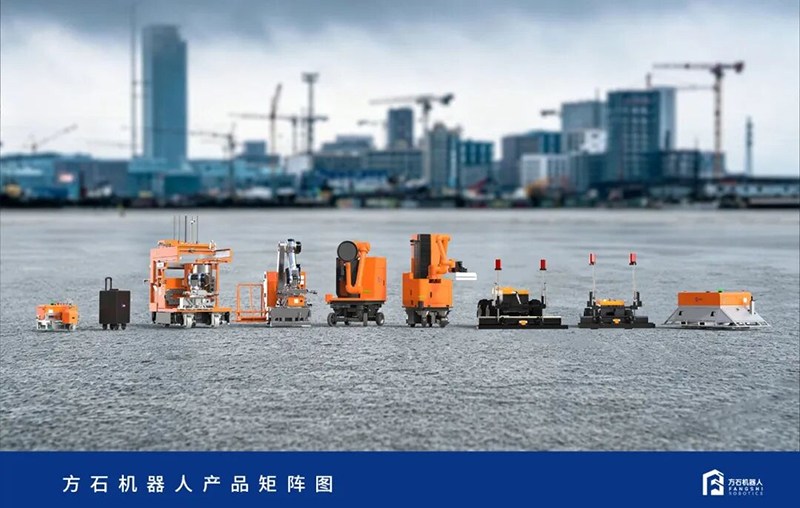
Founded in 2019, Fangshi Robotics is a pioneering enterprise in the commercialization of smart construction robots in China. Focusing on the unmanned and intelligent upgrade needs of construction sites, the company deeply integrates multimodal perception, motion control, and vertical industry large model technologies to create a full-stack self-developed "Embodied AI + Architectural Large Model" AI solution. By empowering robots with autonomous decision-making and complex environment adaptation capabilities, Fangshi Robotics is dedicated to solving core industry pain points such as the aging construction workforce, high-risk operational environments, and low efficiency, driving the transformation of the traditional construction industry toward an efficient, safe, and green smart construction model.
As the added value of China's construction industry continues to stabilize at over 6% of GDP, this pillar industry of the national economy is facing severe structural challenges. Data shows that the number of direct practitioners in the construction industry has shown a clear downward trend overall in recent years, with the decline in 2025 being particularly prominent. Currently, the proportion of workers over the age of 45 has surpassed 60%, while workers under 30 are severely lacking. With the labor force leaving precipitously on one hand, and a massive shortage of skilled talents capable of operating smart equipment on the other, "robots replacing humans" has become an irreversible and rigid trend in the construction industry.
Driven by On-Site Needs Building a Modular Product Matrix and Full-Stack Technical Platform Based on the real scenario needs of construction sites, Fangshi Robotics has launched a modular construction robot product portfolio covering the entire life cycle, including structural construction, secondary structures and decoration, and auxiliary inspection. Deeply integrating cutting-edge technologies such as BIM, artificial intelligence, and big data, the company has built a robot cloud IoT platform. Relying on core capabilities such as real-time perception, real-time motion control, and real-time planning, it has released a full-stack self-developed construction robot operating system.
On this foundation, Fangshi Robotics has formed a commercially viable "Embodied AI + Large Model" AI solution, achieving seamless collaboration of "real-scene perception - intelligent planning - robot execution." Possessing the most comprehensive construction data and scenario information in vertical market segments, the pre-training data dimensions are streamlined, significantly improving model accuracy and engineering deployment efficiency while effectively lowering the application threshold in complex scenarios.
Product Matrix Covering Full Life Cycle Constructing a Closed Loop of "Real-Scene Perception - Intelligent Planning - Robot Execution"
At the current stage, the core product matrix of Fangshi Robotics has covered multiple series, including flooring construction, wall treatment, and floor tile/stone tiling.
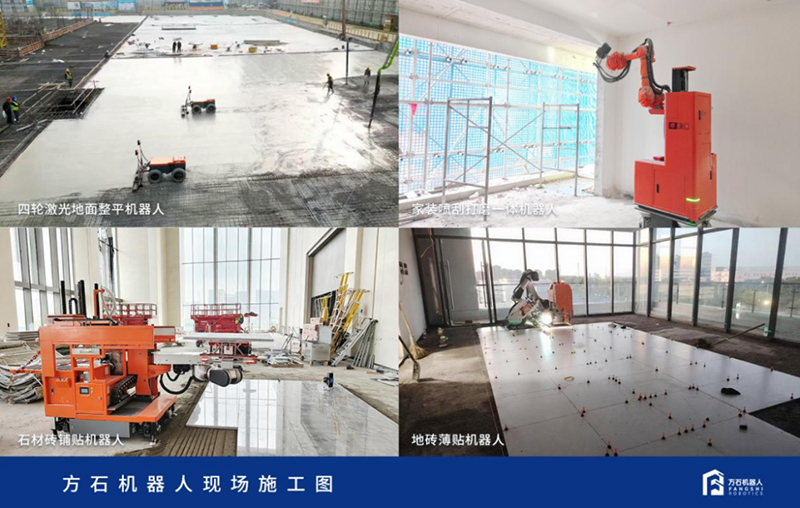
Flooring Construction Series: Including Four-wheel Concrete Laser Screeding Robot, dual-disc smoothing and troweling robots, etc. The products adopt intelligent laser screeding algorithms and wire-controlled chassis technology to achieve unmanned autonomous high-precision construction. The construction efficiency reaches 400 - 600 square meters per hour, with flatness deviation controlled within 5 millimeters, which can significantly save labor costs and shorten the payback period.
Wall and Decoration Treatment Series: Covering residential/garage spray-scraping and sanding integrated robots. Through a six-degree-of-freedom mechanical arm and an omnidirectional mobile chassis, it integrates putty spray-scraping, sanding, and latex paint spraying functions into one, with an operational height covering 3.3 meters to 4.5 meters. It can maintain high positioning accuracy and uniform operational effects even under complex working conditions, effectively ensuring the consistency of construction quality.
Tiling Process Series: Including Ceramic Floor Tile Laying Robot and stone tile laying robots. Supported by a large-load, lightweight robotic arm and an omnidirectional mobile chassis, this series of models achieves full-process automated operations from base treatment and dry sand leveling to precise laying. Through precise force control of the end-effector, the robot can strictly control the tile joint width and the height difference between two tiles within a millimeter-level error range. While significantly improving construction aesthetics and quality consistency, it effectively solves the pain points of high labor intensity in traditional manual tiling and the difficulty of large-format slab construction.
Argos System and Architectural Large Model: Serving as the company's technical brain, the Argos system integrates multi-line LiDAR and vision technology to achieve full-process automation from spatial digitalization and component recognition to path optimization. Combined with the specialized architectural robot large model, Fangshi Robotics has achieved seamless collaboration of "real-scene perception - intelligent planning - robot execution," drastically reducing the planning threshold and deployment difficulty at construction sites.
Embodied AI Reshapes Technical Paradigm Architectural Large Model Builds a Vertical Moat
Construction sites are fundamentally different from industrial production lines: the construction environment is unstructured and dynamically changing, and the spatial layout and site conditions vary from one construction site to another. In the past, limited by perception and control capabilities, construction robots could often only serve as semi-automated tools, relying on manual teaching or full-process auxiliary operations. The cost of human-robot collaboration was high and efficiency was low, restricting large-scale commercial landing.
The gradual maturation of the Embodied AI technical route provides a systemic solution to the aforementioned pain points. By connecting the entire process from front-end digital asset generation and digital space generation to robot model pre-training, Fangshi Robotics constructs an end-to-end reinforcement learning closed-loop embodied ecosystem. It utilizes the construction scenario-specific space generation large model and semantic recognition to provide a foundation for complex scenario adaptability, collects real scenario operation data and teleoperation data to fine-tune the pre-trained model, and integrates upstream and downstream data in market segments to train smart terminals, achieving the self-growth of construction robots and transforming them from execution tools into intelligent agents capable of autonomous perception, decision-making, and adaptation.
At the architectural large model level, general large models do not possess a deep understanding of construction crafts, construction specifications, and site conditions. Fangshi Robotics has accumulated comprehensive construction data and scenario information in the vertical field. The pre-training data dimensions are streamlined and highly focused, significantly enhancing model accuracy and engineering deployment efficiency.
The core assets of Fangshi Robotics are not only the robot hardware itself, but also the continuously accumulated architectural digital assets and industry large models—these capabilities possess platform-like attributes and can be migrated to hardware carriers of different forms, continuously releasing value for a wider range of intelligent construction scenarios in the future.
Commercialization and Globalization Dual-Wheel Drive The Industry Window of Opportunity Has Arrived
FANGSHI ROBOTICS In terms of strategic path, Fangshi Robotics always adheres to the dual-wheel drive of technology R&D and commercial landing. The company is one of the earliest enterprises in China to achieve batch commercial sales of construction robots, build a product matrix covering all construction scenarios, and achieve commercial output overseas.
Regarding the domestic market, Fangshi has deeply served over 100 head construction enterprises such as China State Construction Engineering Corporation and China Railway Construction Corporation, landing over 500 benchmark projects including Guangzhou Baiyun International Airport, with a cumulative construction area exceeding 15 million square meters. Relying on excellent product strength, the company's market share continues to maintain a leading position in the industry.
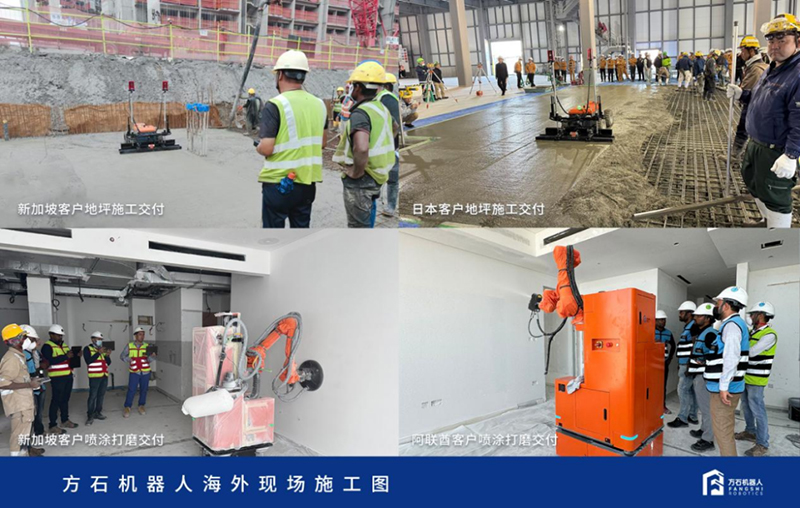
Regarding the overseas market, Fangshi Robotics has demonstrated extremely strong international expansion capabilities. Since its products first entered the Australian market in 2023, it has successfully covered more than ten countries, including the UAE, Russia, and India. Currently, Fangshi Robotics is accelerating the establishment of regional service centers and spare parts warehouses in the Middle East and Southeast Asia, aiming to achieve a leap from product output to localized operations.
Standing at the vanguard of the smart construction era, Fangshi Robotics takes capital empowerment as a new starting point, continuing to deeply cultivate the core technologies of Embodied AI and architectural large models, and constantly perfecting its all-scenario robot product matrix. Breaking through industry pain points with technological innovation, consolidating the industrial foundation with commercial landing, and broadening the development landscape with a global layout, the company is going all out to lead the construction industry into a new era of smart construction.





 Home
Home